Creativity: The Most Forgotten Art
Creativity
is the action of expressing so we feel no fear or judgement of others just like
a child.
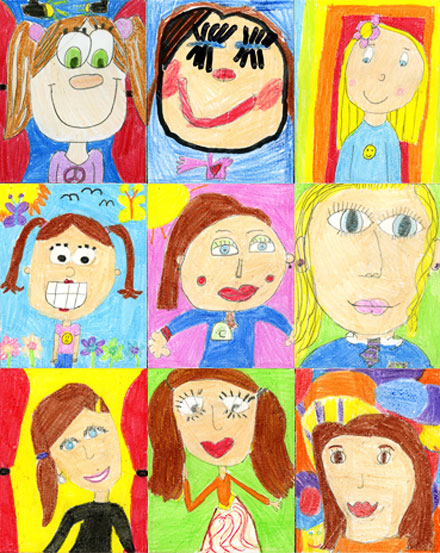 “I heard a great story recently of a little girl who
was in a drawing lesson. She was six, and she was at the back, drawing, and the
teacher said this girl hardly ever paid attention, and in this drawing lesson,
she did. The teacher was fascinated. She went over to her, and she said, ‘What
are you drawing?’ And the girl said, ‘I’m drawing a picture of God.’ And the
teacher said, ‘But nobody knows what God looks like.’ And the girl said, “They
will in a minute.’” (Robinson)
“I heard a great story recently of a little girl who
was in a drawing lesson. She was six, and she was at the back, drawing, and the
teacher said this girl hardly ever paid attention, and in this drawing lesson,
she did. The teacher was fascinated. She went over to her, and she said, ‘What
are you drawing?’ And the girl said, ‘I’m drawing a picture of God.’ And the
teacher said, ‘But nobody knows what God looks like.’ And the girl said, “They
will in a minute.’” (Robinson)
Bob McKim was a creativity
researcher in the 1960’s and 1970’s along with teaching at Stanford University.
One of the exercises that he would do with his students would be to have them
very quickly draw their neighbor. Tim Brown experimented with this exercise
during a lecture and found the same results that McKim stumbled upon; after
the thirty seconds were up, the adults would go though a process where they
would laugh, show embarrassment, and then say sorry.
If you try this same experiment with
children, they have no embarrassment at all. They will show their masterpieces
off to anyone who will look , but as they learn to become adults, they become
more sensitive to the opinions of others and replace the freedom of creativity
with embarrassment. (Brown)
McKim believed that the findings related to how the adult students would act showed that we fear the judgement
of our peers. This fear is what causes us to be conservative in our thinking. In
a talk about creativity with Elizabeth Gilbert, author of Eat, Pray, Love, she stated that “You cannot get rid of fear, but
do remember that fear is boring.” (Gilbert)
Besides fear and embarrassment, why are we as adults stopping
the creative process from happening?
 I believe that we are stopping the
creative process from happening because we have lost our imagination. “One of
the things we tend to do as adults is we edit things. We stop ourselves from
doing things. We self-edit as we are having ideas. In some cases, our desire to
be original is actually a form of editing. That actually is not necessarily
really playful. So that ability just to go for it and explore lots of things,
even if they do not seem that different from each other, is actually something
that children do well, and it is a form of play.” (Brown)
I believe that we are stopping the
creative process from happening because we have lost our imagination. “One of
the things we tend to do as adults is we edit things. We stop ourselves from
doing things. We self-edit as we are having ideas. In some cases, our desire to
be original is actually a form of editing. That actually is not necessarily
really playful. So that ability just to go for it and explore lots of things,
even if they do not seem that different from each other, is actually something
that children do well, and it is a form of play.” (Brown)
Sir Ken Robinson, an internationally
recognized leader in the development of creativity, believes that it is
the educational system that is hindering children’s creativity. Robinson states that, “Kids will take a chance. If they do
not know, they will have a go. They are not frightened of being wrong. I do not
mean to say that being wrong is the same thing as being creative. What we do
know is, if you are not prepared to be wrong, you will never come up with
anything original. By the time they get to be adults, most kids have lost that capacity. The result is that we are educating people out of their creative incapacitates.”
 Our education system is predicated on the idea of academic
ability. Around the world, there were no public systems of education before the
19th century. They all came into being to meet the needs of
industrialism in a two tiered academic hierarchy: the most useful subjects for
work are at the top and academic ability. The consequence is that many
highly-talented, creative people think they are intelligent, because the thing
that they were good at at school was not valued, or was actually stigmatized. Every education system on Earth has the same hierarchy of subjects. At the top are mathematics and languages, then the
humanities, and at the bottom are the arts. (Robinson)
Our education system is predicated on the idea of academic
ability. Around the world, there were no public systems of education before the
19th century. They all came into being to meet the needs of
industrialism in a two tiered academic hierarchy: the most useful subjects for
work are at the top and academic ability. The consequence is that many
highly-talented, creative people think they are intelligent, because the thing
that they were good at at school was not valued, or was actually stigmatized. Every education system on Earth has the same hierarchy of subjects. At the top are mathematics and languages, then the
humanities, and at the bottom are the arts. (Robinson)
When we do this to children we are
taking away imagination and replacing it with serious thoughts. Take a small
child at Christmas into consideration. It is not uncommon for a small child to
be more interested in the box that the toy came in than the actual toy itself. From
an exploration perspective, this behavior makes complete sense because you can
do quite a bit more with boxes than you can do with a toy. (Brown) Actually,
the oldest, cheapest, and most diversely used toy is the stick. It can be
anything from a magic wand to a sword. ("National Toy Hall of Fame: Stick.")
We need to harness this creativity
that children have with a stick back into our daily adult lives, but the
question is how do we do this? I have no definite answer for anyone. I know
that currently as a current creative student, I live within the boundary lines of
grades, and as a creative adult, I will live within the boundary lines of costs
of my project ideas. Though my research of re-finding creativity, I found that
there is not one path to relearning creativity. It is a personal believe that
if we are to re-find our creative nature, we need to look into the eyes of a
child and see how they are to handle a situation. Children are our keys to eliminating fear and embarrassment and relearning creativity.

Works Cited
Brown, Tim. “Tales of Creativity and
Play.” TED. May 2008. Lecture
Gilbert,
Elizabeth. "Fear Is Boring, and Other Tips for Living a Creative
Life." Ideastedcom. TED Talks, 24 Sept. 2015. Web. 1 Nov. 2015.
"National
Toy Hall of Fame: Stick." National Museum of Play. The Strong,
2008. Web. 1 Nov. 2015.
Robinson, Ken. “Do Schools Kill
Creativity.” TED Febuary 2006. Lecture

No comments:
Post a Comment