Monday, November 30, 2015

Day Seven: Rest and the Greatest Gifts of All

Day Seven: Rest and the Greatest Gifts of All
God rested on the seventh day from all the work that he had done. These are the generations of the heavens and the earth when they were created. In the day that the LORD God made the earth and the heavens, when no plant of the field was yet in the earth and no herb of the field had yet sprung up - for the LORD God had not caused it to rain upon the earth, and there was no one to till the ground; but a stream would rise from the earth, and water the whole face of the ground - then the LORD God formed man from the dust of the ground, and breathed into his nostrils the breath of life; and the man became a living being. And the LORD God planted a garden in Eden, in the east; and there he put the man whom he had formed. Out of the ground the LORD God made to grow every tree that is pleasant to the sight and good for food, the tree of life also in the midst of the garden, and the tree of the knowledge of good and evil…..
- Genesis 2:1-10 (Aitken, Robert)
This is the end to the story about how God gave us the greatest gift of life, knowledge, power, and freewill. Ultimately, I know that God gave us the greatest gift of life. Though this gift, I believe that He also gave us the power of freewill when He placed the Tree of Knowledge of Good and Evil in the Garden of Eden. God was gifting us with knowledge and free thought to use the talents he gave us to choose if we wanted to follow his one rule he gave us: “Be fruitful and multiply, fill the earth and subdue it; have dominion every living thing that moves upon the earth.” (Aitken, Robert) To me, this means that God is not only granting us with as much power of freewill that we can handle, but the power to control the earth and animals on it as the most dominate species to ever exist.

With this power of freewill, I believe that it is in our best interest to keep in mind that in the same book in the bible, God plays out a story of destroying almost the whole world to start anew. (Aitken, Robert) The famous story of Noah is only six chapters behind the story of creation in the book of Genesis. In the story of Noah, God is upset with the choices that the human race is making and has decided to save only one family and two of all of the animals on earth. This really brings question to just how much freewill humans have. Yes, we have been given the ability of choice, knowledge, and power, but are we disillusioned with how much freewill we have?

I do not believe so. I believe that when we wholeheartedly believe in God and everything that He has done, then we know truths that do not need a scientific explanation or a high level thought process. For years, this was something I had a hard time grasping until I realized that when I choose to be on the path that God is leading me on, then I am not giving up my freewill, but instead I am freely making the choice to follow. I still have the freewill to make mistakes and oh yea, I do those quite often, but these mistakes have a purpose now that I have chosen to have God guide me. With God guiding me, my mistakes are never a mistake. They are unanswered prayers in the form of learning experiences that helped me to keep on the path that I have chosen to be on.

Philosophically, I do not expect anyone to understand my point of view. In a study conducted in 2013 of almost 2,000 philosophers, 72.8% of them claim to be atheist when asked about God, yet when asked about freewill, 59.1% adhere to compatibilism freewill. (Gonzalez, Robbie) Oddly enough, some of the most influential philosophers of the past were among the strongest believers in God’s existence. These philosophers include Kant and Hegel. (Gray, James W., Wallace, Robert.)

Kant believes that “we have freewill if practical reason can determine our actions” and that “God is a metaphor for the ability for our moral goals to succeed.” (Gray, James W.) Hegel on the other hand believes that “If there is a higher degree of reality that goes with being self-determining (and thus real as oneself), and if we ourselves do in fact achieve greater self-determination at some times than we achieve at other times, then it seems that we’re familiar in our own experience with some of the higher degree of reality that we associate with God.” (Wallace, Robert)
 
I do not necessary believe that neither man is wrong in their thoughts, nor do not 100% align my views with either. Kant’s and my ideas of freewill differ in the aspect that I do not believe that there needs to be a practical reasoning behind everything. I believe that some things just happen without an explanation, which is why I align more with Hegel’s thoughts of God.

No matter what your view is of faith, freewill, or religion, we all have the right to believe what we want and to understand situations in whatever way we feel necessary. I believe that God was the creator of all human and animal life and only by choosing God’s path, will you truly be able to surpass your rights to freewill.


Works Cited

Aitken, Robert. The Holy Bible. American Bible Society ed. New York: Arno, 1968. Print.

Gray, James W. "Kant's Argument for Faith in God." Ethical Realism. Wordpress, 28 Jan. 2010. Web. 1 Dec. 2015.

Gonzalez, Robbie. "What Percentage of Philosophers Believe in God?" Io9: We Come From the Future. 30 Apr. 2013. Web. 1 Dec. 2015.

Wallace, Robert. "Hegel’s God." Hegel’s God. Philosophy Now, 2011. Web. 1 Dec. 2015.


Saturday, November 21, 2015

What is our obligation to alive creatures?

What is our obligation to alive creatures? 

Our obligation is to complete the life cycles that God has planned for us to carry out without altering the food chain in a negative way.

4:30 AM - WINTER 1999.
I was deep into sleep when my dad woke me up. It was time to go. It was time when no one else knew we would be leaving. A time where we wouldn’t disturb anyone. Not even the sun was awake.

We left and walked deep into the woods; deep into the darkness. We walked as fast, but made no sound until we reached the clearing. Then we finally were able to sit. I looked up at my dad, but he didn’t look at me. He was keeping watch…then it happened. Without making a sound, we took a life.

Philosophers throughout time have debated what our moral obligation to alive creatures are. As humans, we have the largest mental capacity along with the ability to take the life of any creature we please for more than survival. (Suddendorf, Thomas) I believe that our obligation is to complete the life cycles that God has planned for us to carry out without altering the food chain in a negative way.

Medieval Christian philosopher Thomas Aquinas believed that God had a part to play in the obligations of humans. He argued that God established a hierarchy of life forms in nature so that the lower forms may be killed and eaten by all higher forms. (Carroll, William) I fully agree with this position. In simple terminology, it is stating that plants are to be killed by animals for food, and animals are to be killed by humans for food.

For Aquinas, animals lack reason and exhibit motion by a kind of natural impulse. This indicates that they are naturally enslaved and accommodated to the uses of others. Ancient philosopher, Porphyry, disagrees with this point of view. He believes that animals are rational and, because of this, deserve justice in the same way that humans do. (Emilsson, Eyjólfur)

I disagree in the sense that I do not believe that animals deserve the same level of justice in the same way that humans do. As humans, we have the capacity to imagine and create, which is something that animals do not have. (Suddendorf, Thomas) Yes, I believe that we need to treat animals with respect, as they are another form of life, but I do not believe that they are on the same level as humans.

Both Aquinas and Porphyry’s point of view lead to the study of Environmental Ethics. It is “discipline in philosophy that studies the moral relationship of human beings to, and also the value and moral status of, the environment and its non-human contents.” It was developed into a specific philosophical discipline in the 1970s due to the increasing awareness in the 1960s of the effects that technology, industry, economic expansion and population growth were having on the environment. (Brennan, Andrew)
Upon looking at both of these philosopher’s point of views, I believe that they both need to consider that it is a rational animistic instinct to follow the food chain. (“Food Chain”) All animals have the need to survive and intertwined in this need is the need for food. As humans, we are at the top of the food chain due to our knowledge and technology.

One of our moral obligations to animals is to maintain the top of the food chain by having ethical conditions on which we kill. “Choosing ethically raised meat helps you get all the advantages of meat without negatively impacting the health of the planet. (Jacob, Aglaee) These animals that are raised this way are also killed in an ethical way. Not only this, but humans require the nutrients that come from animals to maintain their survival. No matter if we choose to eat meet or not, I believe that we need to be ethical.
Maintaining our obligation to complete the life cycles that God has planned for us to carry out is respected in the death process of animals for many years. Cherokee tribes conducted post-kill rituals to their gods that would start four days before a hunting trip and last until four days after to purify the spirit to please the spirits. After killing an animal, “Cherokee hunters would ask the gods' forgiveness for taking the animal's life. If a deer is killed, they would throw the tongue and some of its meat into the fire as a sacrifice.” (Broadley, Jacob) Their moral obligations to animals always related back to respecting their gods, the natural food chain, and the environment.


6:30 AM – WINTER 1999
It was my first kill. We had just taken the life of a twelve point deer with a bow and arrow. Just like the rest of our deer tags, it was a perfectly clean kill. One shot. The deer didn’t feel any pain. Now we were going to have enough deer meet to last until the next deer season.

When we talked up to the lifeless animal, we thanked God for providing us with food and the animal for giving us his life. We had fulfilled our moral obligation to complete the food chain the way that God had planned it.


Works Cites
Brennan, Andrew. "Environmental Ethics." Stanford University. Stanford University, 3 June 2002. Web. 22 Nov. 2015.

Broadley, Jacob. "Cherokee Hunting Traditions | The Classroom | Synonym." Cherokee Hunting Traditions | The Classroom | Synonym. Demand Media. Web. 22 Nov. 2015.

Carroll, William E. "Creation, Evolution, and Thomas Aquinas." Creation, Evolution, and Thomas Aquinas. Catholic Education Resource Center, 2003. Web. 21 Nov. 2015.

Emilsson, Eyjólfur. "Porphyry." Stanford University. Stanford University, 18 Feb. 2005. Web. 22 Nov. 2015.

"Food Chain." National Geographic Education. National Geographic, 11 Dec. 2010. Web. 22 Nov. 2015.

Jacob, Aglaee. "The Disadvantages of a Diet With Little Meat." Healthy Eating. Demand Media. Web. 22 Nov. 2015.


Suddendorf, Thomas. "Why Playing “House” as a Kid Is What Separates Us From the Animals." Science: The State of the Universe. Slate, 3 Mar. 2014. Web. 22 Nov. 2015. 

Sunday, November 1, 2015

Creativity: The Most Forgotten Art

Creativity: The Most Forgotten Art
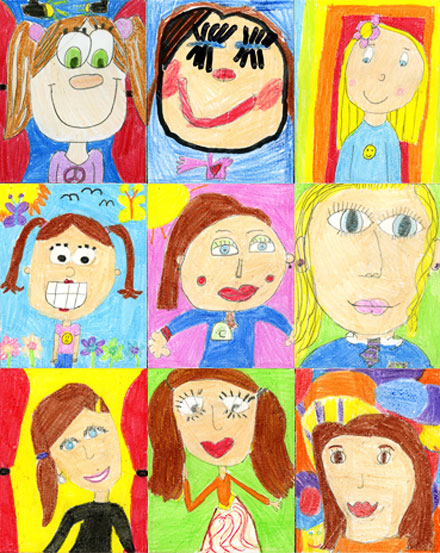
Creativity is the action of expressing so we feel no fear or judgement of others just like a child.

“I heard a great story recently of a little girl who was in a drawing lesson. She was six, and she was at the back, drawing, and the teacher said this girl hardly ever paid attention, and in this drawing lesson, she did. The teacher was fascinated. She went over to her, and she said, ‘What are you drawing?’ And the girl said, ‘I’m drawing a picture of God.’ And the teacher said, ‘But nobody knows what God looks like.’ And the girl said, “They will in a minute.’” (Robinson)

Bob McKim was a creativity researcher in the 1960’s and 1970’s along with teaching at Stanford University. One of the exercises that he would do with his students would be to have them very quickly draw their neighbor. Tim Brown experimented with this exercise during a lecture and found the same results that McKim stumbled upon; after the thirty seconds were up, the adults would go though a process where they would laugh, show embarrassment, and then say sorry.

If you try this same experiment with children, they have no embarrassment at all. They will show their masterpieces off to anyone who will look , but as they learn to become adults, they become more sensitive to the opinions of others and replace the freedom of creativity with embarrassment. (Brown)
McKim believed that the findings related to how the adult students would act showed that we fear the judgement of our peers. This fear is what causes us to be conservative in our thinking. In a talk about creativity with Elizabeth Gilbert, author of Eat, Pray, Love, she stated that “You cannot get rid of fear, but do remember that fear is boring.” (Gilbert)
Besides fear and embarrassment, why are we as adults stopping the creative process from happening?

I believe that we are stopping the creative process from happening because we have lost our imagination. “One of the things we tend to do as adults is we edit things. We stop ourselves from doing things. We self-edit as we are having ideas. In some cases, our desire to be original is actually a form of editing. That actually is not necessarily really playful. So that ability just to go for it and explore lots of things, even if they do not seem that different from each other, is actually something that children do well, and it is a form of play.” (Brown)

Sir Ken Robinson, an internationally recognized leader in the development of creativity, believes that it is the educational system that is hindering children’s creativity. Robinson states that, “Kids will take a chance. If they do not know, they will have a go. They are not frightened of being wrong. I do not mean to say that being wrong is the same thing as being creative. What we do know is, if you are not prepared to be wrong, you will never come up with anything original. By the time they get to be adults, most kids have lost that capacity. The result is that we are educating people out of their creative incapacitates.” 

Our education system is predicated on the idea of academic ability. Around the world, there were no public systems of education before the 19th century. They all came into being to meet the needs of industrialism in a two tiered academic hierarchy: the most useful subjects for work are at the top and academic ability. The consequence is that many highly-talented, creative people think they are intelligent, because the thing that they were good at at school was not valued, or was actually stigmatized.  Every education system on Earth has the same hierarchy of subjects. At the top are mathematics and languages, then the humanities, and at the bottom are the arts. (Robinson)

When we do this to children we are taking away imagination and replacing it with serious thoughts. Take a small child at Christmas into consideration. It is not uncommon for a small child to be more interested in the box that the toy came in than the actual toy itself. From an exploration perspective, this behavior makes complete sense because you can do quite a bit more with boxes than you can do with a toy. (Brown) Actually, the oldest, cheapest, and most diversely used toy is the stick. It can be anything from a magic wand to a sword. ("National Toy Hall of Fame: Stick.")

We need to harness this creativity that children have with a stick back into our daily adult lives, but the question is how do we do this? I have no definite answer for anyone. I know that currently as a current creative student, I live within the boundary lines of grades, and as a creative adult, I will live within the boundary lines of costs of my project ideas. Though my research of re-finding creativity, I found that there is not one path to relearning creativity. It is a personal believe that if we are to re-find our creative nature, we need to look into the eyes of a child and see how they are to handle a situation. Children are our keys to eliminating fear and embarrassment and relearning creativity.


Works Cited

Brown, Tim. “Tales of Creativity and Play.” TED. May 2008. Lecture

Gilbert, Elizabeth. "Fear Is Boring, and Other Tips for Living a Creative Life." Ideastedcom. TED Talks, 24 Sept. 2015. Web. 1 Nov. 2015.

"National Toy Hall of Fame: Stick." National Museum of Play. The Strong, 2008. Web. 1 Nov. 2015.


Robinson, Ken. “Do Schools Kill Creativity.” TED Febuary 2006. Lecture