He that smiteth a man, so that he die, shall be
surely put to death…and if a man come presumptuously upon his neighbor, to slay
him; thou shall be put to death …but if any harm follow, then thou shalt give
life for life, eye for eye, tooth for tooth, hand for hand, foot for foot,
burning for burning, wound for wound, stripe for stripe….
Exodus 21:12, 14, 23-25 ("Exodus 21, American Standard Version (ASV).")

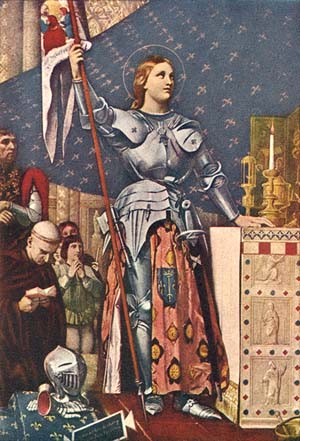
Joan of Arc was burned at the stake
on May 30, 1431. (
Trial of Joan of Arc - Sections of Introduction) According
to biblical teachings at the time, the people who burned her, should have been
burned themselves, but they were not. This was because the people who had deemed
her as dead did this because they believed that they were acting correctly in
the eyes of the Lord. They were the ones who were sent to rid the world from
the evil, but why was a nineteen year old who started hearing voices from God
when she was thirteen tried for witchcraft and heresy? ("Joan of
Arc.")
Joan of Arc believed that God had
chosen her to lead France in the battles against the English. (Trial of Joan
of Arc) As we know,
she has not been one of the only people to believe that God has led them to do
things or that they are a manifestation of God even in the dark ages. The
Hermetic Order of the Golden Dawn claim to be a direct descent around 1614. (The Golden Dawn - Introduction to the
First Edition) Some better known “manifestations of God” include Charles
Manson and David Koresh.
So how do we really know if someone
has been set by God to carry out His word? Better off yet, how do we know the
truth from a lie when interrogating someone? I truly believe that there is no
correct or best practice to this answer, but currently the police use tactics
like the Reid Technique which is better known as “good cop, bad cop”, informal
questioning, or lying. (Mince-Didier, Ave)
Another way that is used around the world to get a confession
is torture. “Governments around the world are two-faced on torture –
prohibiting it in law, but facilitating it in practice” says Salil Shetty,
Amnesty International’s Secretary General, speaking at the launch of their new ‘Stop
Torture’ campaign. The Amnesty put out a survey to 144 different countries and
found that “The vast majority of respondent (82%) believe there should be clear
laws against torture, however more than a third (36%) still thought torture
could be justified in certain circumstances.” ("World Without
Torture.") What does this say about
our world? That torture is justified as long as the truth is known?

If this is the case, why do we just
not administer a truth serum to every criminal put on trial? Yes these
mind-altering drugs do actually exist and are not just a thing for the movies,
but they are not as effective as they are in the movies. They do not completely
inhibit the criminal’s ability to lie. They actually show the speed at which
your body sends messages from your spinal cord to your brain which make it
difficult to perform a high-functioning task like walking straight or lying. (Orwig,
Jessica.) According to Washington Post reporter David Brown: "In the 21st century, however, the
answer appears to be: No. There is no pharmaceutical compound today whose
proven effect is the consistent or predictable enhancement of truth-telling."
(Brown, David)
So with this being known, when is
it ethical to use torture to get an answer from people? In a BBC report they describe
a “ticking bomb problem”. In this scenario a terrorist group says they have concealed
a nuclear bomb and the authorities have captured the leader of this group. The
leader says that he knows where the bomb is but he will take the location of
the bomb to his death. The situation has drastically increased and torture is
guaranteed to produce the information needed to ensure the authorities find and
disable the bomb. So would it be ethical to torture the group leader to find
out where the bomb is and save thousands of lives or is it unethical to torture
him and have thousands die as a result? “In this situation torturing the
terrorist is unethical and can’t be justified, but I can be understood, and it
can be forgiven and is seen as the right thing to do.” (BBC News)
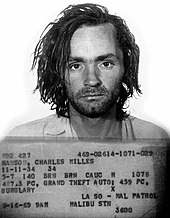
At the age of 77, Charles Manson
was placed into solitary confinement. (Killoran, Ellen) In a United Nations report, solitary confinement is classified as
“cruel, inhuman or degrading treatment or punishment and even torture” ("Special
Rapporteur on Torture…) This is a man who brainwashed people into believing
that he was God and lead these people to torture and kill others, yet there are
people who believe that it in unethical to torture this man by putting him in a
cell with his own thoughts so that, just like a small child being reprimanded,
he will be able to sit there and think about what he had done.
Is torture ethical? Are these people reincarnations of God?
Did Joan of Arc speak with God? I believe that we will never truly know the
100% right or wrong answer to this question and it is all up to interpretation
per the situation.
Works Cited
BBC News. BBC, 2014. Web. 4 Oct. 2015.
Brown, David. "Some Believe 'Truth Serums' Will Come
Back." Washington Post. The Washington Post, 20 Nov. 2006. Web. 5
Oct. 2015.
"Exodus
21, American Standard Version (ASV)." Exodus 21, American Standard
Version (ASV). Web. 4 Oct. 2015.
"Joan of Arc." History.com. A&E
Television Networks. Web. 4 Oct. 2015.
Killoran, Ellen. "Charles Manson Parole 2012: At 77,
Notorious Criminal Still Has Family Of Supporters." International
Business Times. IBT Media, 9 Apr. 2012. Web. 4 Oct. 2015.
Mince-Didier, Ave. "Tactics Police Use to Get a
Confession | Criminal Law." CriminalDefenseLawyer.com. NOLO Local
Defense Lawyers. Web. 4 Oct. 2015.
Orwig, Jessica. "The Real Truth Behind How
'Truth-Telling' Drugs Actually Work." Business Insider. Business
Insider, Inc, 10 Oct. 2014. Web. 4 Oct. 2015.
"Special Rapporteur on Torture Tells Third Committee
Use of Prolonged Solitary Confinement on Rise, Calls for Global Ban on Practice
| Meetings Coverage and Press Releases." UN News Center. UN, 18
Oct. 2011. Web. 4 Oct. 2015.
The Golden Dawn - Introduction to the First Edition.
14-18, 45-48. Print.
Trial of Joan of Arc - Sections of Introduction. 1-3,
26-32. Print.
"World Without Torture." World Without Torture.
RSS, 13 May 2014. Web. 4 Oct. 2015.


 An example of
one of these stories would be out of the Book of John in the Bible. In this
book, Jesus went to a party with his mother, Mary. Mary believed in the power
which Jesus possessed and asked him if he would provide food and drink for the
people attending as there was no food or drink left. Jesus willed his power,
which could be substituted to thinking that his power was magic, to turn water
into wine and produce more bread and fish. (Aitken) In this
story, Jesus had many believers and used his will and magic to produce a miracle.
None of this can be explained by science or by philosophy, yet it was an act
that happened.
An example of
one of these stories would be out of the Book of John in the Bible. In this
book, Jesus went to a party with his mother, Mary. Mary believed in the power
which Jesus possessed and asked him if he would provide food and drink for the
people attending as there was no food or drink left. Jesus willed his power,
which could be substituted to thinking that his power was magic, to turn water
into wine and produce more bread and fish. (Aitken) In this
story, Jesus had many believers and used his will and magic to produce a miracle.
None of this can be explained by science or by philosophy, yet it was an act
that happened.  “Page and
Crowley… shared a fascination with ‘will’….as magic is an art of bringing the
will to bear on what is.” (Auxier) Page and Crowley believed in
anything that actually happened, yet they needed an explanation for everything.
They believed in cause and effects due to their scientific background. Instead
of believing in a higher being, Page and Crowley have similar thoughts to the
ones expressed thus far, yet they believed in science as a God. They noticed
that these magical actions were happening and, through determination, they
found answers in their scientific knowledge much like how I find answers in my
religious believes.
“Page and
Crowley… shared a fascination with ‘will’….as magic is an art of bringing the
will to bear on what is.” (Auxier) Page and Crowley believed in
anything that actually happened, yet they needed an explanation for everything.
They believed in cause and effects due to their scientific background. Instead
of believing in a higher being, Page and Crowley have similar thoughts to the
ones expressed thus far, yet they believed in science as a God. They noticed
that these magical actions were happening and, through determination, they
found answers in their scientific knowledge much like how I find answers in my
religious believes.